
← Korea Market Scout / Field Reports
Beyond Seafood: What BISFE 2026 Revealed About the Commercial Structure of Korea’s Marine Economy
Field analysis from the Busan International Seafood & Fisheries Expo 2026
Busan, South Korea | November 2026
Field observations and photographs by Tanya Moroz
From 4 to 6 November 2026, Busan hosted the 24th Busan International Seafood & Fisheries Expo (BISFE 2026). According to the official post-show results, the event brought together 535 companies from 32 countries across 1,300 booths and attracted 18,302 visitors. International buyer meetings and export consultations generated 1,306 consultations worth approximately USD 85 million, while 110 potential export contracts worth around USD 15 million remained under active pursuit.
Official post-show release: Busan Metropolitan City
Those figures establish the scale of the event, but they say little about what was actually happening inside the market.
I attended BISFE as an independent market researcher. The objective was not simply to look at products, but to understand the commercial ecosystem around Korea’s seafood and marine industries: who manufactures, who imports, who processes, which technologies are moving toward commercialization, which institutions support companies, and where foreign businesses may find practical entry points.
After the exhibition, I was left with dozens of catalogues, product samples, photographs and a stack of business cards roughly 2.5 centimetres thick. Most individual companies can be found online. What is much harder to find is the system connecting those companies, public infrastructure, technologies and trade channels. That was the most valuable outcome of BISFE 2026.
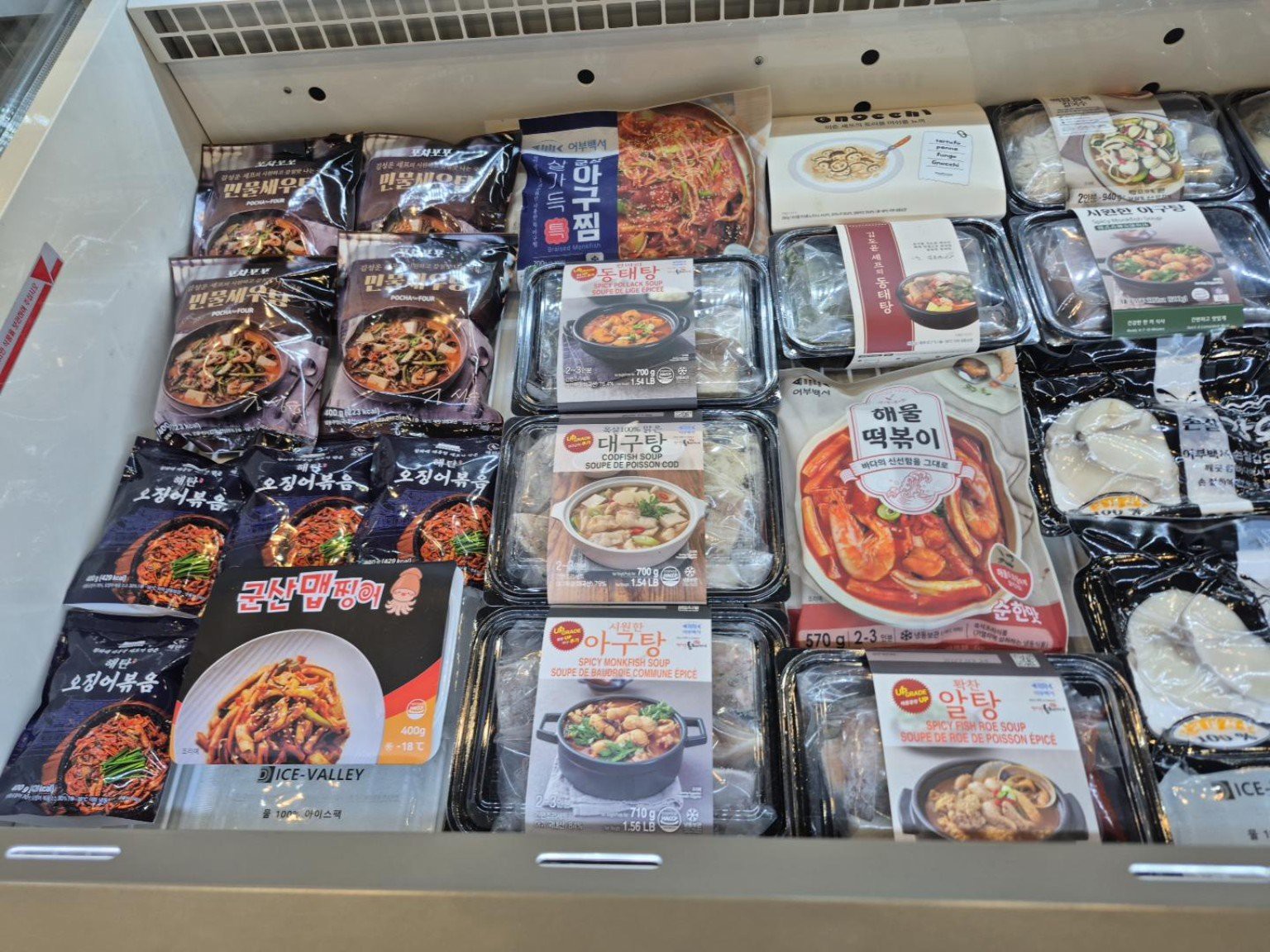
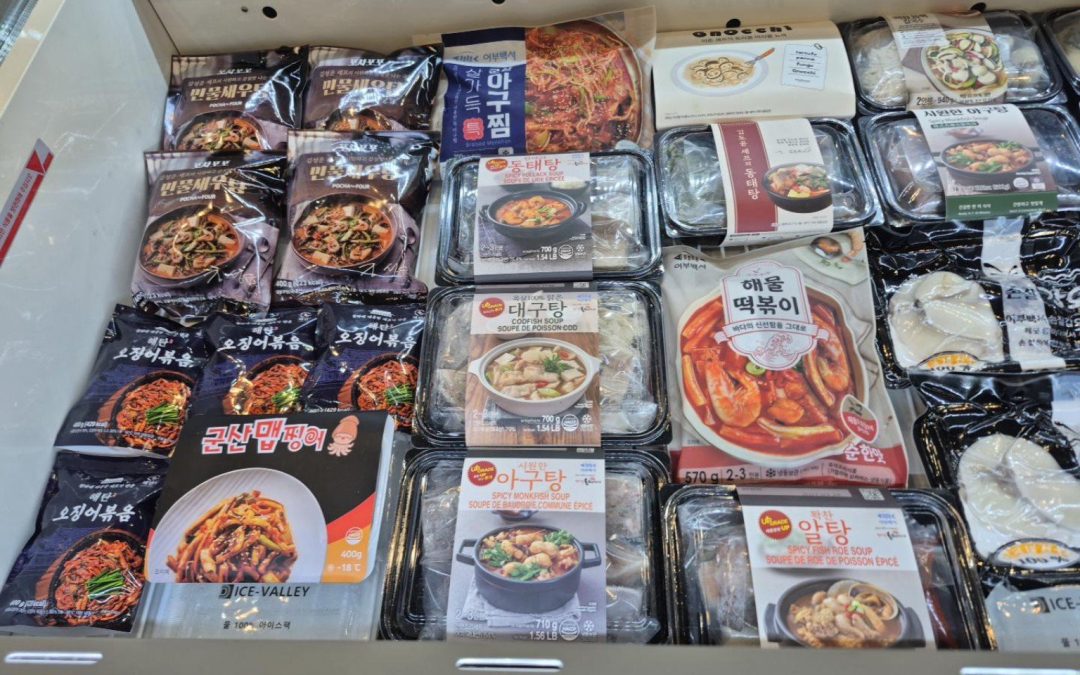
Ready-to-cook soups, seafood tteokbokki and other HMR products show the shift from commodity seafood toward convenience and higher value. Photo: Tanya Moroz.
1. BISFE is not simply a seafood show. It is a cross-section of the marine economy
At first glance, BISFE can look straightforward: fish, crab, squid, seaweed and frozen products. Yet the official structure of the exhibition is much broader, covering seafood, processing equipment, smart aquaculture, marine biotechnology, start-ups, investment, international pavilions and distribution platforms.
On the same exhibition floor were manufacturers and processors, importers and trading companies, OEM/private-label producers, equipment and cold-chain suppliers, regional technology parks, R&D centres, export organisations, industry associations and government agencies.
That distinction matters. If the market is viewed only through fishery output and production statistics, a large share of the commercial value chain disappears from view.

Processing equipment on the exhibition floor highlights the industrial technology layer of Korea’s seafood value chain. Photo: Tanya Moroz.
2. The central commercial shift: value is created after the catch
One of the most consistent signals across the show was the depth of processing. Many exhibitors were not selling “fish as fish” to the final customer. Red snow crab becomes graded meat, pastes, extracts, sauces, canned products and ingredients for food manufacturing. Eel becomes cleaned fillets, pre-grilled portions and retail-ready products. Fish becomes marinated products, soups, meal kits, HMR and ready-to-cook formats.
Premiumisation runs in parallel. Regional origin such as Jeju, Namhae or Yeongdeok becomes part of the product proposition; traditional fish cake is differentiated through local ingredients and premium packaging; ordinary seafood is repositioned as a gift product or a modern convenience format.
This is no longer simply a contest over the price per kilogram of raw material. It is a contest over how much value can be created from that kilogram.
For foreign suppliers, processors and equipment companies, that points to opportunities not only in commodity seafood, but also in ingredients, processing technologies, packaging, HMR, OEM/private label and differentiated products.

Daeho Fisheries illustrates how regional Korean producers move from raw seafood into higher-value processed crab products. Photo: Tanya Moroz.

Crab is commercialized not only as meat but also as sauces, extracts and food-industry ingredients. Photo: Tanya Moroz.
3. The marine economy is expanding far beyond seafood
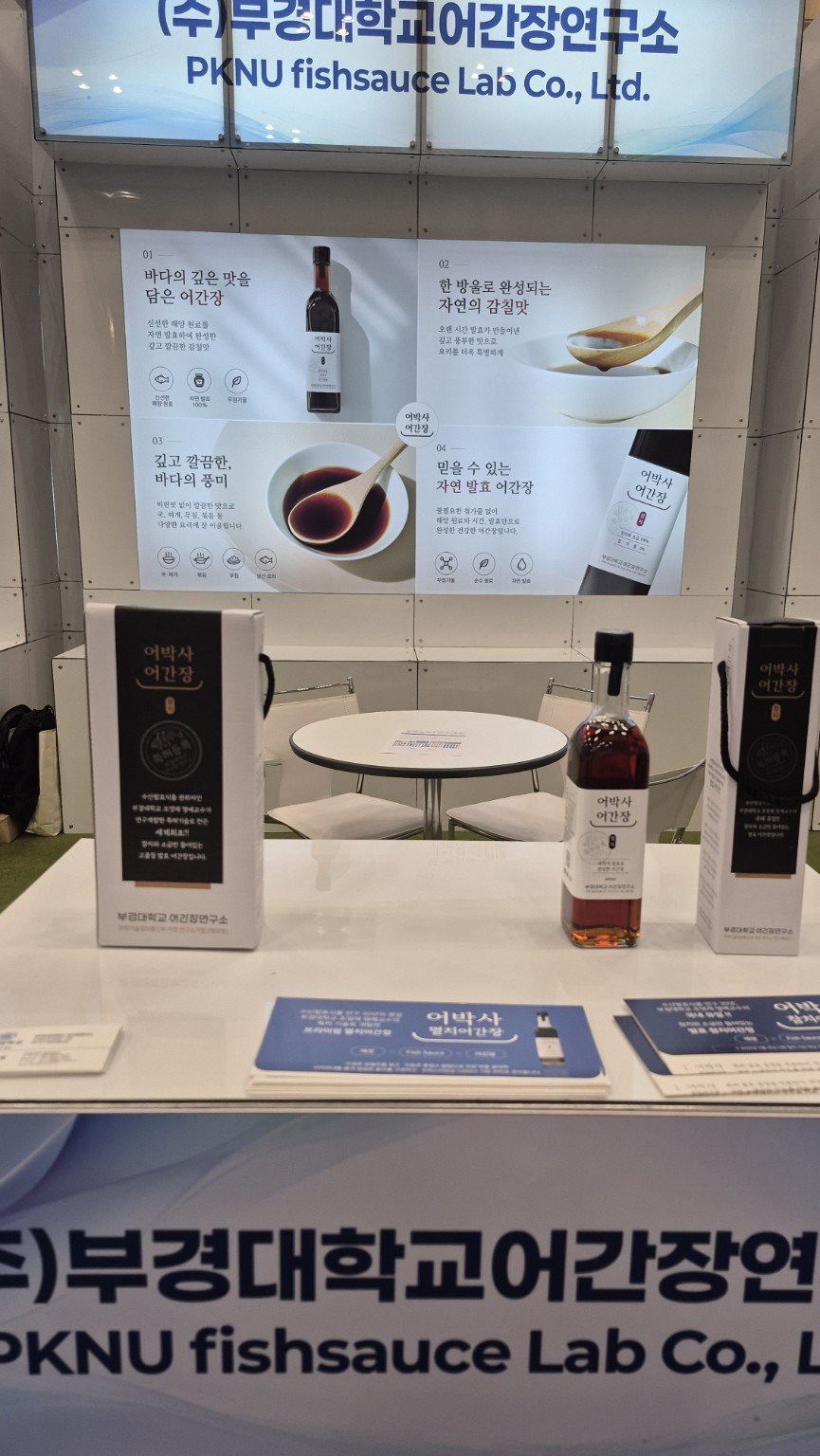
Some of the most revealing exhibits appeared where the sea stopped being only a source of food. Jeju Lava Ocean presented LAVA 0.9, a liquid mineral stick linked to Jeju lava seawater resources and used when cooking rice. BNGBIOME is developing specialty coffee incorporating marine-derived components. H&A BIO links functional beverages with aquaculture-related biotechnology. At the DERMARE and Wando stands, marine resources were already being commercialised in cosmetics and biotech products.
Commercially, this broadens the category itself. The marine economy increasingly overlaps with food-tech, functional ingredients, cosmetics, wellness and biotechnology. For technology scouts, investors and research houses, these intersections may be more informative than another list of frozen-fish suppliers.
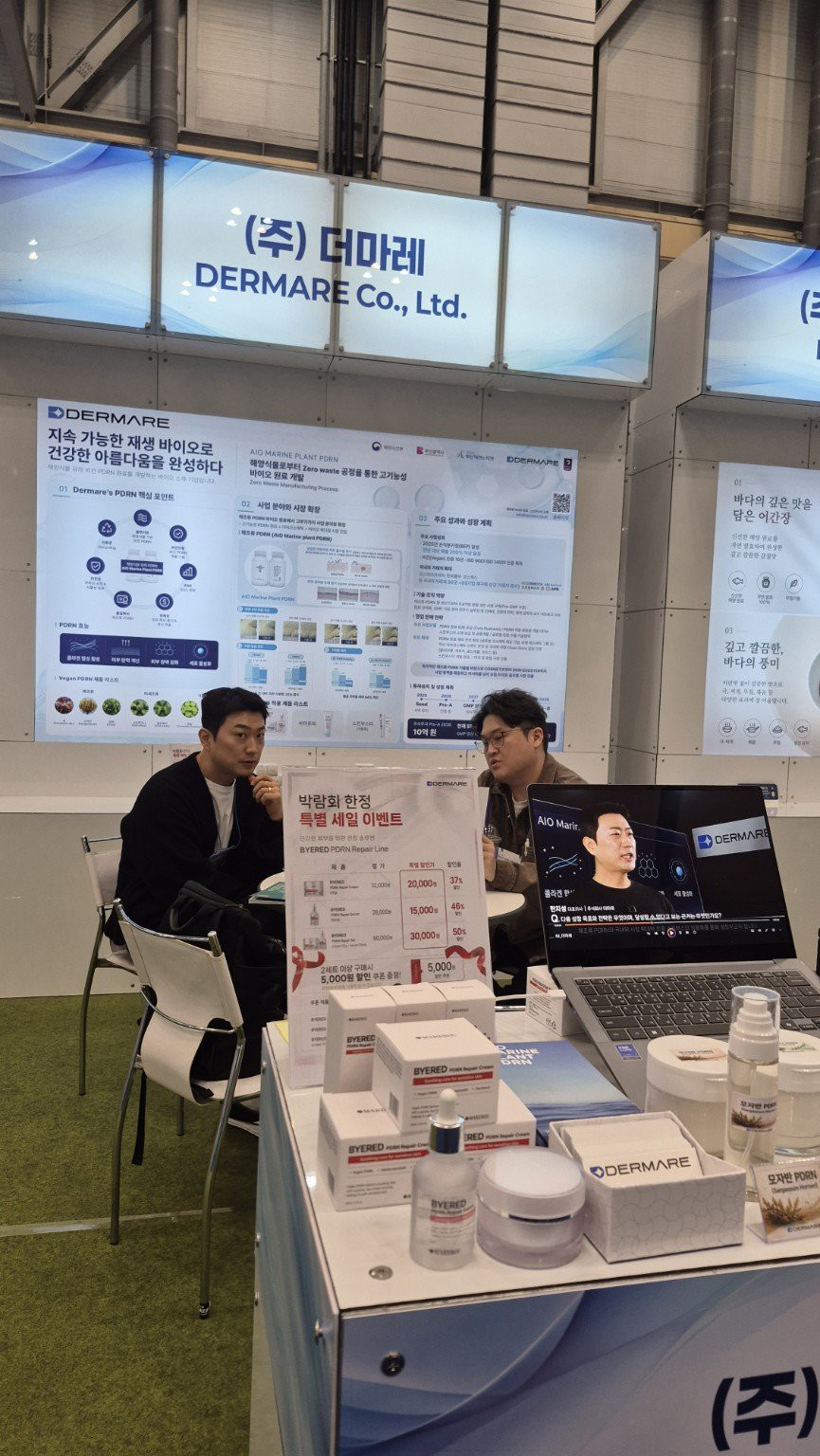
DERMARE shows how Korea’s marine economy is expanding beyond seafood into biotechnology, cosmetics and high-value bio-based products. Photo: Tanya Moroz.
4. A small company does not necessarily mean a small support infrastructure
To a foreign buyer, the Korean market can appear fragmented: many SMEs, limited English-language information and unfamiliar brands. BISFE revealed the other side of that picture: an individual SME may sit inside a substantial regional support infrastructure.
A good example is Chungnam Techno Park. Its marine-bio infrastructure includes microorganism and microalgae cultivation, PCR and RT-PCR, NGS, FPLC, Prep-HPLC, HPLC, LC-MS/MS and GC-MS, together with pilot-production facilities for materials, foods and cosmetics. In practical terms, the chain can run from material research and genomic analysis to separation, purification and pilot manufacturing.
Chungnam Techno Park: official equipment and support overview
For a foreign client, one contact at such a centre can be more valuable than ten random business cards.
It may provide access to tenant companies, research projects, pilot facilities and technologies that remain difficult to identify through conventional search alone.
The West Coast Marine Bio Cluster maps an integrated path from R&D and certification to manufacturing and commercial production. Photo: Tanya Moroz.
5. Government support is not only about subsidies: it is embedded in operating infrastructure
Public and regional support appeared repeatedly across BISFE, but not as a vague slogan about “supporting exports”. The system is divided into practical functions: R&D, pilot production, certification, IP protection, FTA and rules-of-origin procedures, e-commerce, overseas exhibitions, buyer matching and commercialisation.
A strong example is the Mokpo Seafood Export Complex. According to Mokpo City, KRW 117.9 billion was invested in the complex, which integrates processing, research, logistics and export infrastructure, including 36 rental processing units. That lowers the entry barrier for companies that do not need to build an entire factory and support system from scratch.
For a foreign partner, this changes how an SME should be assessed. The relevant question is not only how large the company is, but which laboratories, production facilities, export centres and public programmes it can access.
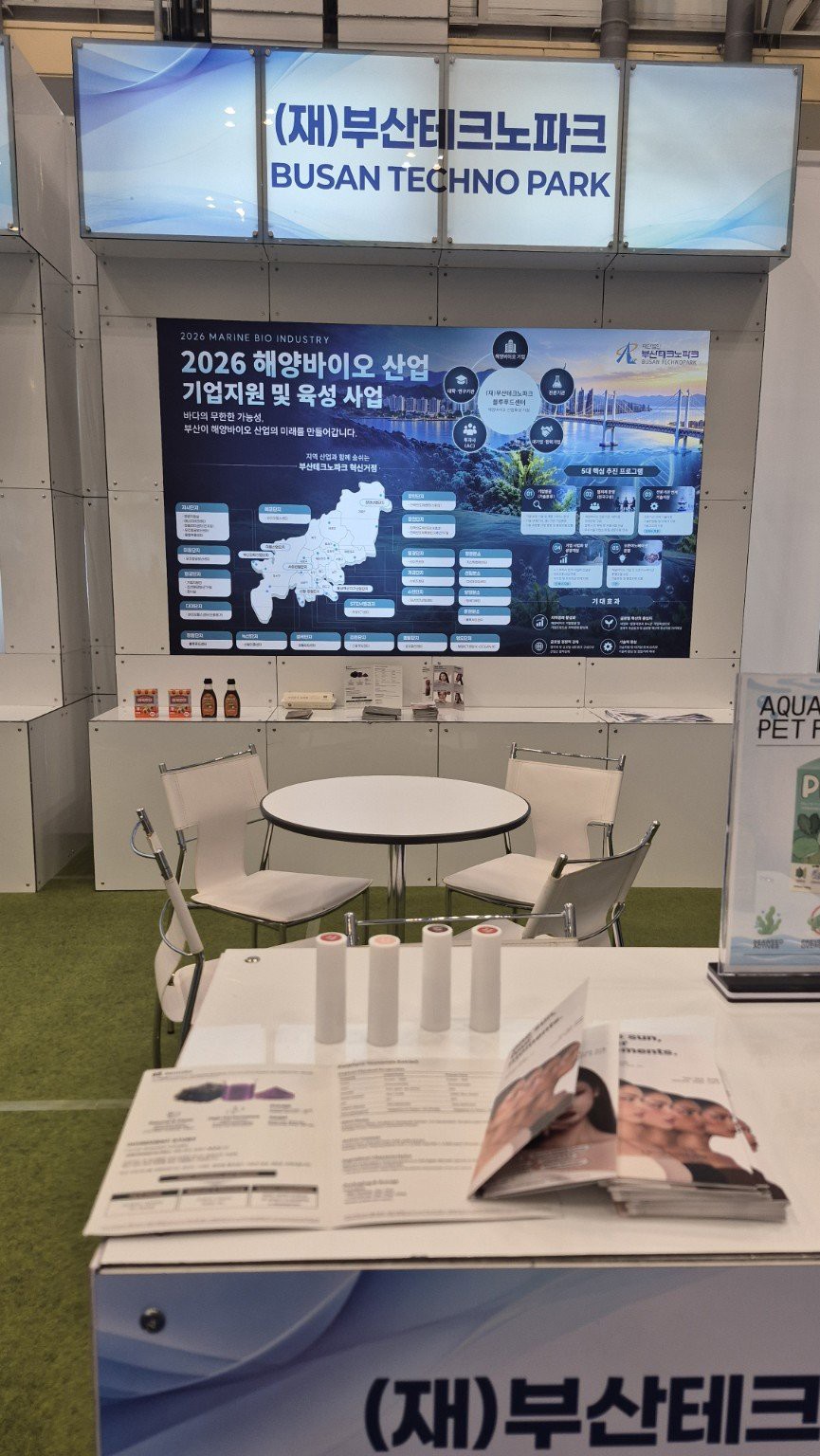
Busan Techno Park presented a dedicated 2026 program for supporting and developing marine bio companies. Photo: Tanya Moroz.
6. Institutional gateways can be more valuable than long supplier lists
Some of the most useful BISFE contacts were not manufacturers at all: Korea Fisheries Association, Busan Customs, Mokpo Seafood Export Center, Mokpo Marine Food-Industry Research Center, Jeonnam Bioindustry Foundation, Chungnam Techno Park and regional start-up investment programmes.
One institutional contact can potentially open access to an entire group of manufacturers, start-ups or research projects. For a market-entry consultant or sector analyst, identifying the right institutional gateway can therefore be more valuable than finding another fifty company names in a database.
This is where local field intelligence starts to differ from ordinary desk research: the task is not only to identify a company, but to understand who inside the ecosystem can lead a researcher to the right companies faster and with greater confidence.
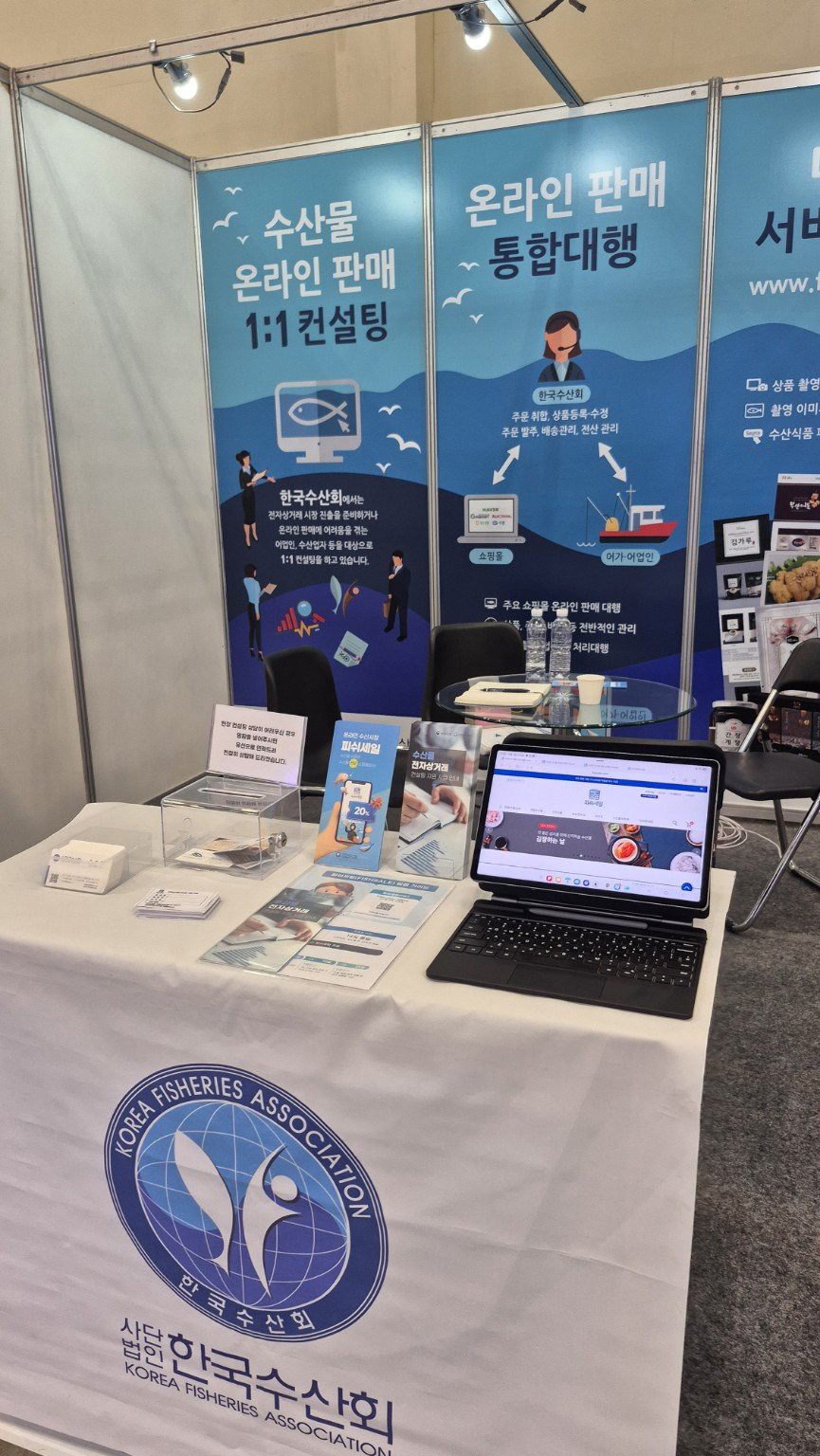
The Korea Fisheries Association offered practical support for seafood e-commerce, including one-to-one consulting and integrated online sales services. Photo: Tanya Moroz.
7. Busan is not only a production base. It is trade infrastructure
Busan International Fish Market shows what the market looks like beyond the exhibition booth. It is a public wholesale market with an auction system, intermediary wholesalers, imported and deep-sea products, cold storage, mechanised logistics, electronic auctions and one-stop support for customs and quarantine. Official market information lists 25,000 metric tonnes of refrigerated and cold-storage capacity.
Busan International Fish Market: official overview · Facilities
For a foreign company seeking to sell seafood into Korea, this is critical. The market does not consist only of producers. It also depends on distribution nodes, importers, intermediary wholesalers, registered buyers and the actual channels through which product moves.
That is why a Google list of Korean companies is only a starting point. The commercial questions come next: who really imports the relevant category, who supplies retail or HoReCa, which formats are already on the market, and what requirements apply to packaging, certification and shipment size.

Busan International Fish Market represents the trading and distribution infrastructure behind Korea’s seafood market. Photo: Tanya Moroz.
8. BISFE works in both directions: Korea is both seller and buyer
The exhibition included national and corporate participants from the United States, Finland, Malaysia, Pakistan, India, China, Vietnam and other countries. They were not there merely to observe Korean exports. They were selling shrimp, shellfish, milkfish, squid, crab, pelagic fish and other products into Korea.
Official post-show figures show that 167 overseas companies from 31 countries participated in BISFE 2026. This supports an important commercial point: BISFE is not only a showcase for Korean exports; it is also an entry point into the Korean import market.
Busan Metropolitan City, post-show results
For Korea market scouting, that creates two distinct assignments. One is to identify Korean suppliers and technologies for foreign clients. The other is to help foreign producers understand Korean demand, competitive offerings, potential importers and sales channels.
9. Finland demonstrated how a country can package an industry as a single B2B proposition
One of the most useful materials collected at BISFE was the Finnish Pavilion brochure. Its value was not the number of companies, but the logic of the national offer.
For each company, the brochure brought together the information a buyer needs: products, production capacity, potential export volumes, MOQ, minimum shipment, lead time, packaging, shelf life, logistics, Incoterms, certifications and existing export markets. Contact details for Finnish commercial representatives in Korea were provided alongside the company information.
The result was not a collection of flags and promotional slogans, but a structured supplier portfolio. For smaller exporting nations, the lesson is significant:
Competition is not only between products. It is also between the quality of national export packaging.

Finland presented its seafood sector at BISFE 2026 as a coordinated national B2B offering for the Korean market. Photo: Tanya Moroz.
10. What this means for foreign companies, investors and consultancies
For a company seeking to sell into Korea, the key questions are not only market size but real importers, buyers, product formats, pricing logic and the competitive offer already on the ground.
For a company sourcing from Korea, the opportunity set extends beyond conventional seafood exporters to OEM/private label, HMR, ingredients, processing technology, marine biotechnology, smart aquaculture and regional production clusters.
For investors, the important signals are infrastructural: where new capacity is being built, which regions are receiving support, which technologies are moving from R&D toward commercialisation, how cold-chain and processing clusters are organised, and where new production capacity is emerging.
For consultancies, competitive-intelligence firms and research houses, a local specialist can deliver a Korean field module: exhibition intelligence, company checks, competitor observations, product and technology scouting, interviews, supplier validation, cluster research and photographic documentation. That material can then be integrated into a broader market-entry project, investment study, client report or industry publication.
11. Where Google ends and fieldwork begins
Most individual facts in this article can be found online. It is possible to find Daeho Fisheries, the Chungnam Techno Park page, the Mokpo Export Complex description or BISFE statistics. That is why the promise “I can find information that is not on Google” is no longer a strong value proposition on its own.
The value of field intelligence lies elsewhere: seeing what a company is prioritising now; comparing it with neighbouring competitors; identifying the person responsible for the business line; collecting the materials that are actually handed to professional visitors; spotting the links between SMEs and regional institutions; checking products and packaging; asking pre-agreed questions; and converting those observations into a commercial conclusion.
BISFE 2026 made that distinction very clear. Korea’s seafood industry increasingly looks less like a standalone fish market and more like a layered system:
raw material → deep processing → convenience → premiumisation → functional products → biotechnology, surrounded by a second layer of R&D → pilot production → certification → logistics → commercialisation → export support.
For an external observer, the individual elements of that system are accessible through desk research. Seeing them together, identifying recurring signals and locating the practical commercial entry points is much easier from inside the market.
Sources and methodology
Field sources. Personal attendance at BISFE 2026 in Busan; photographs of booths and products; catalogues, business cards and information materials collected on site; product samples; direct contacts with exhibitors and industry organisations. The Finland case is based on the official Finnish Pavilion brochure collected at the exhibition.
Open-source verification. After the event, field observations were cross-checked against primary official Korean sources, including Busan Metropolitan City, BISFE, Chungnam Techno Park, Mokpo City and Busan International Fish Market.
Note: this article is not a complete catalogue of all 535 exhibitors. It is a field-intelligence sample designed to identify structural commercial signals that become visible when on-the-ground observation is combined with subsequent source verification.
Official source links
- Busan Metropolitan City — BISFE 2026 post-show results
- BISFE 2026 — official exhibition overview and categories
- Chungnam Techno Park — marine bio equipment and pilot support
- Mokpo City — Mokpo Seafood Export Complex completion release
- Busan International Fish Market — market overview
- Busan International Fish Market — facilities and cold-storage capacity
Prepared as an independent Korea field-intelligence case study. The public article intentionally presents structural findings rather than the full underlying contact database, supplier matrix or private field notes.
Field research and photographs: Tanya Moroz, Busan, South Korea.
← Back to Korea Market Scout / Field Reports | Capacity Home
CAPACITY / KOREA MARKET SCOUT
Need someone on the ground in South Korea?
Tell us what you need. Let’s discuss how we can help.
Based in Busan, South Korea
Connect on LinkedIn
© 2026 CAPACITY | South Korea · Europe
We use the information you provide to respond to your inquiry.
You can also email us at info@capacity.ee.