

← Korea Market Scout / Field Reports
Korea Build & Living & Lifestyle Busan 2026: What I Saw on the Ground
A field intelligence report for European companies looking at South Korea’s building, interior, home and lifestyle market
Busan, South Korea | October 2026
Field observations and photographs by Tanya Moroz
I visited Korea Build and Living & Lifestyle in Busan at BEXCO in October 2026 to look at the exhibition not simply as a visitor, but through the eyes of a European company trying to understand the Korean market.
The two exhibitions were held simultaneously from 1 to 4 October 2026 at BEXCO. Korea Build is positioned as the largest building, architecture and interior exhibition in Korea’s southeastern region, while Living & Lifestyle brings together interior solutions, furniture, home appliances, accessories, healthcare and consumer lifestyle products. Both are organised by Messe Esang. 코리아빌드 : 대한민국 대표 글로벌 건축박람회, 인테리어 박람회
Final 2026 visitor and exhibitor figures were not yet publicly available when this report was prepared. For context, the certified statistics for the 2025 Busan Korea Build recorded 110 exhibiting companies and 16,756 visitors. The organiser separately reported 17,356 visitors for the 2025 Busan Living & Lifestyle exhibition. akei
What interested me most, however, was not the headline numbers.
It was the mismatch between what looked familiar from a European perspective and what was unmistakably Korean.
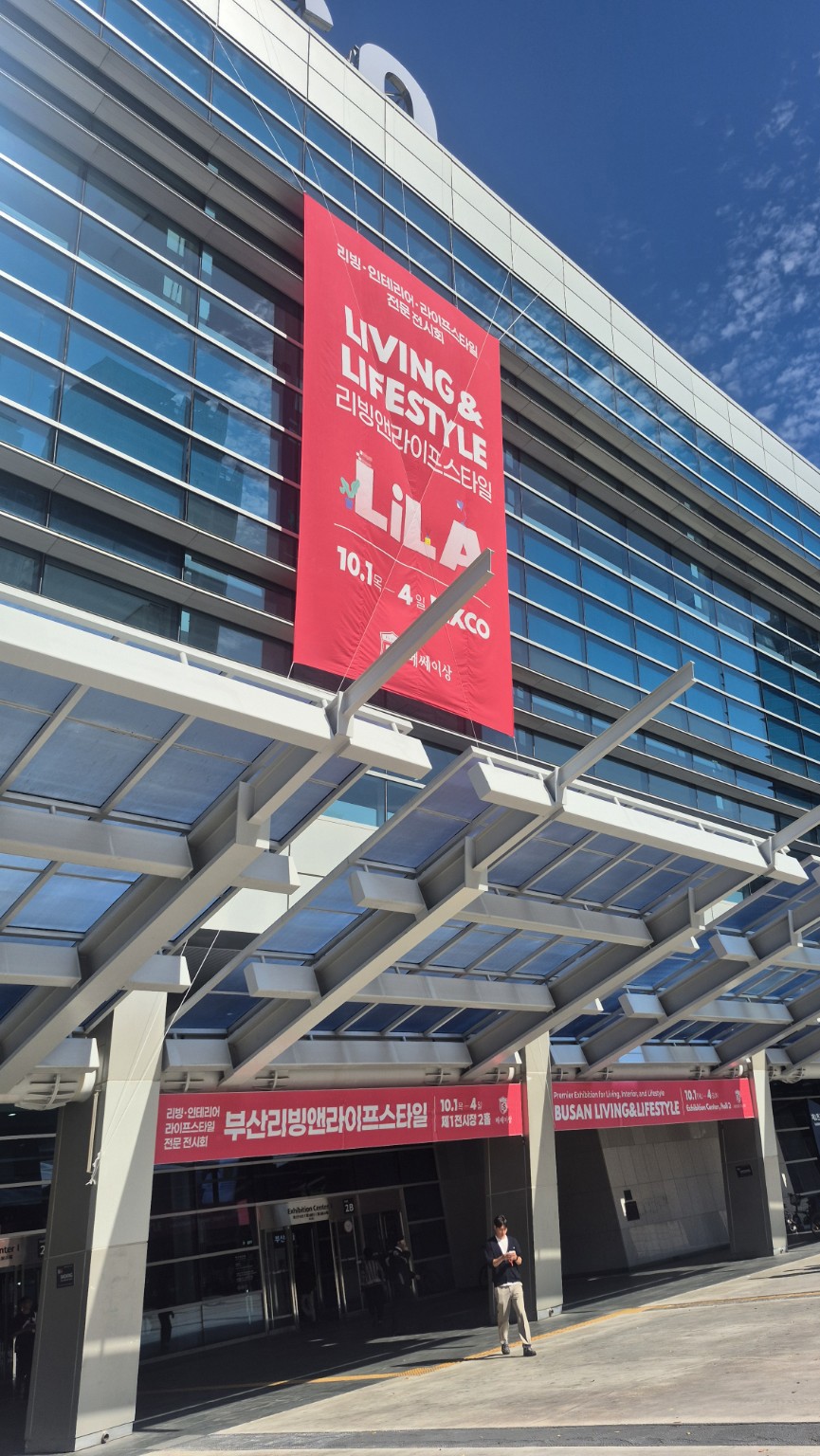
Living & Lifestyle exhibition entrance at BEXCO, Busan. Photo: Tanya Moroz.
Seven things that stood out on the exhibition floor
1. Korean residential architecture looked much less “Asian” than I expected
One of my first impressions was how familiar many residential projects looked.
The architectural concepts, small houses and residential presentations I saw would not have appeared out of place at a building exhibition in Northern or Central Europe. The shapes, materials, colour palettes and presentation style were surprisingly international.
That observation matters.
A European architecture, modular-house or building-material company should not automatically assume that entering Korea means adapting its entire visual language to something radically unfamiliar.
At least within the residential concepts I saw in Busan, there appeared to be substantial aesthetic common ground.
The official exhibition itself placed considerable emphasis on modular construction, including real modular units, steel, concrete and timber structures, prefabrication, insulation, waterproofing and digital design technologies. 코리아빌드 : 대한민국 대표 글로벌 건축박람회, 인테리어 박람회
Market question: Which European residential products could enter Korea with relatively limited aesthetic adaptation?
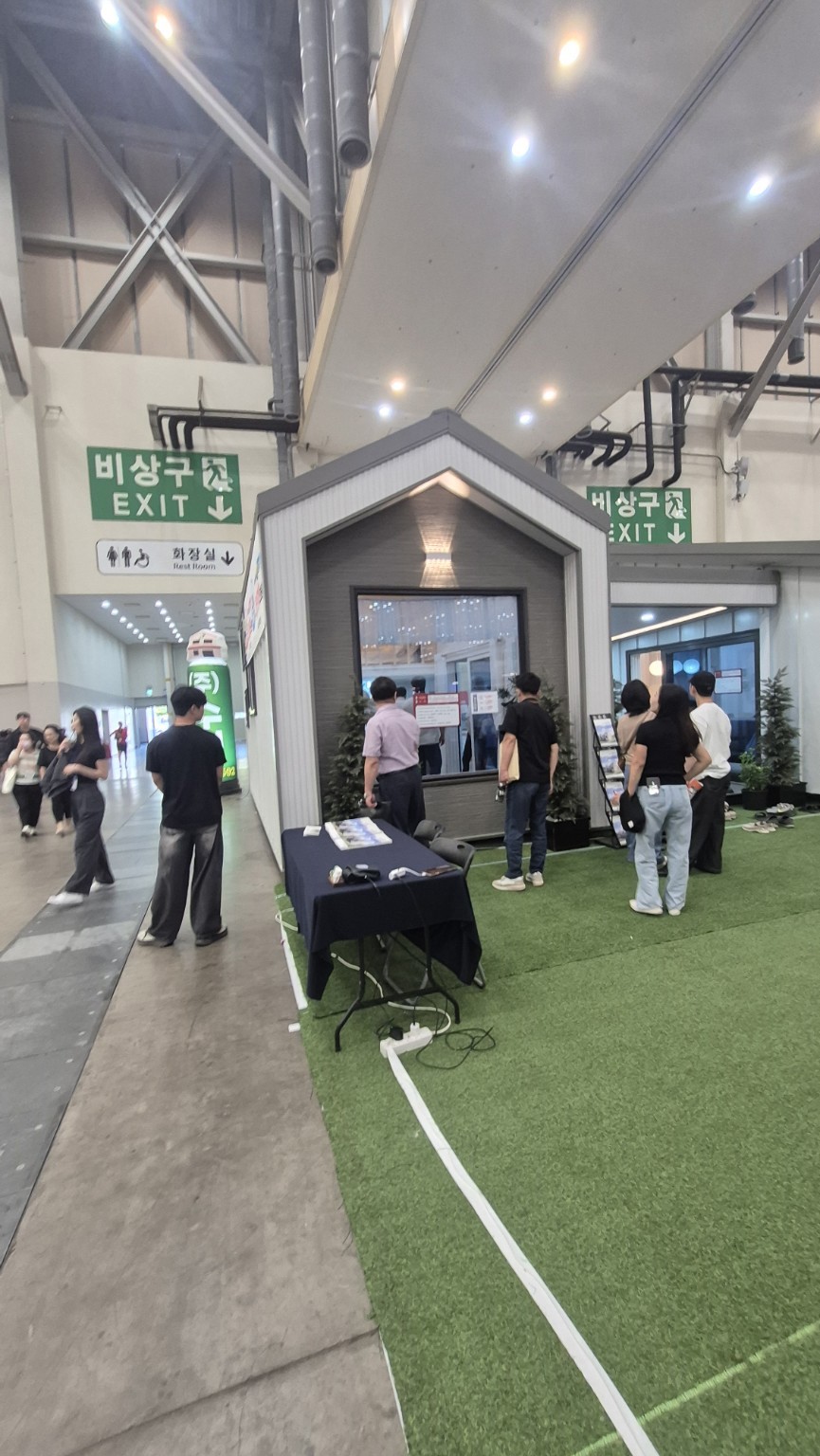
Modular small house on display at Korea Build. Photo: Tanya Moroz.
2. Siding attracted attention despite a surprisingly limited visible offer
One of the most interesting small observations came from exterior cladding.
The siding offer I saw appeared relatively narrow compared with what I am accustomed to seeing in European building markets. Yet one siding display attracted a noticeable group of visitors.
That combination caught my attention:
limited visible choice + clear visitor interest.
It is far too early to call this a market gap. One exhibition cannot establish nationwide demand or supply.
But it is exactly the kind of discrepancy worth investigating.
For a European manufacturer of façade systems, siding, exterior panels or related products, I would want to know:
- which exterior cladding systems dominate Korean detached-house construction;
- how concentrated the supplier market is;
- whether imported European systems are already present;
- what technical standards and certification requirements apply;
- and whether the visitor interest I observed reflects broader demand.
This is the difference between exhibition sightseeing and field intelligence: the useful output is often not an answer, but a question worth spending money to answer.
3. Flooring was officially part of the exhibition, but surprisingly weak on the ground
This was another discrepancy.
The organiser explicitly listed flooring among the interior-material categories, including solid wood flooring, engineered flooring, laminate, ceramic tile and PVC tile. 코리아빌드 : 대한민국 대표 글로벌 건축박람회, 인테리어 박람회
Yet during my visit, flooring did not appear visually prominent.
Coming from Europe, where parquet, laminate and other decorative flooring systems often occupy substantial exhibition space, I found the category unexpectedly subdued.
That does not mean that Korea lacks a developed flooring market.
It could mean something else entirely:
- flooring may be sold through different channels;
- Korean apartments may rely more heavily on standardised systems;
- major flooring manufacturers may simply not have participated;
- other materials may dominate;
- or flooring may not be an exhibition-driven purchase category in the same way.
For a European flooring producer, this is an obvious research lead.
Field observation: the category was less visible than I would have expected from its importance in European building exhibitions.
4. The most genuinely Korean product difference I saw was in the kitchen
The kitchen sinks were among the products I found most interesting.
Several were wider and longer than many European kitchen sinks I am accustomed to seeing. But the important difference was not simply their dimensions.
It was the relationship between the sink design and Korean household food-waste habits.
South Korea requires food waste to be separated from ordinary household waste, and local authorities instruct residents to remove excess liquid before disposal. Separate food-waste containers and collection systems are standard parts of everyday waste management. dobong.go.kr
The sink systems I observed incorporated removable strainer or basket arrangements that make it easy to rinse dishes, retain solid food residues and remove those solids separately.
Similar drain-basket products are widely sold in Korea specifically to prevent food material from entering the drain and to make removal easier. costco.co.kr
For me, this was a perfect example of something an online product catalogue can fail to explain:
The product is shaped by the behaviour surrounding it.
A European manufacturer looking at a Korean sink might simply see an unusually large basin and different hardware.
A person living in Korea sees the connection with the everyday food-waste routine.
That distinction matters in market entry.
Commercial question: Could Korean sink and food-waste separation solutions have applications in European markets as separate food-waste collection becomes more important?
5. The strongest visual difference was not inside the house, but outside it
If the architecture felt surprisingly familiar, the landscape design did not.
The garden and landscape presentations felt far more culturally distinct.
The treatment of stone, plants, sculptural elements and spatial composition produced a very different atmosphere from the mainstream European garden design I know.
This suggests something important for European suppliers:
localisation requirements may differ sharply between product categories.
A European architectural solution may travel relatively easily.
A European outdoor-living or garden concept may require much deeper adaptation to Korean aesthetic preferences.
I would not yet attempt to define “the Korean garden” from one trade fair. That deserves its own study.
But the contrast was strong enough to be commercially relevant.
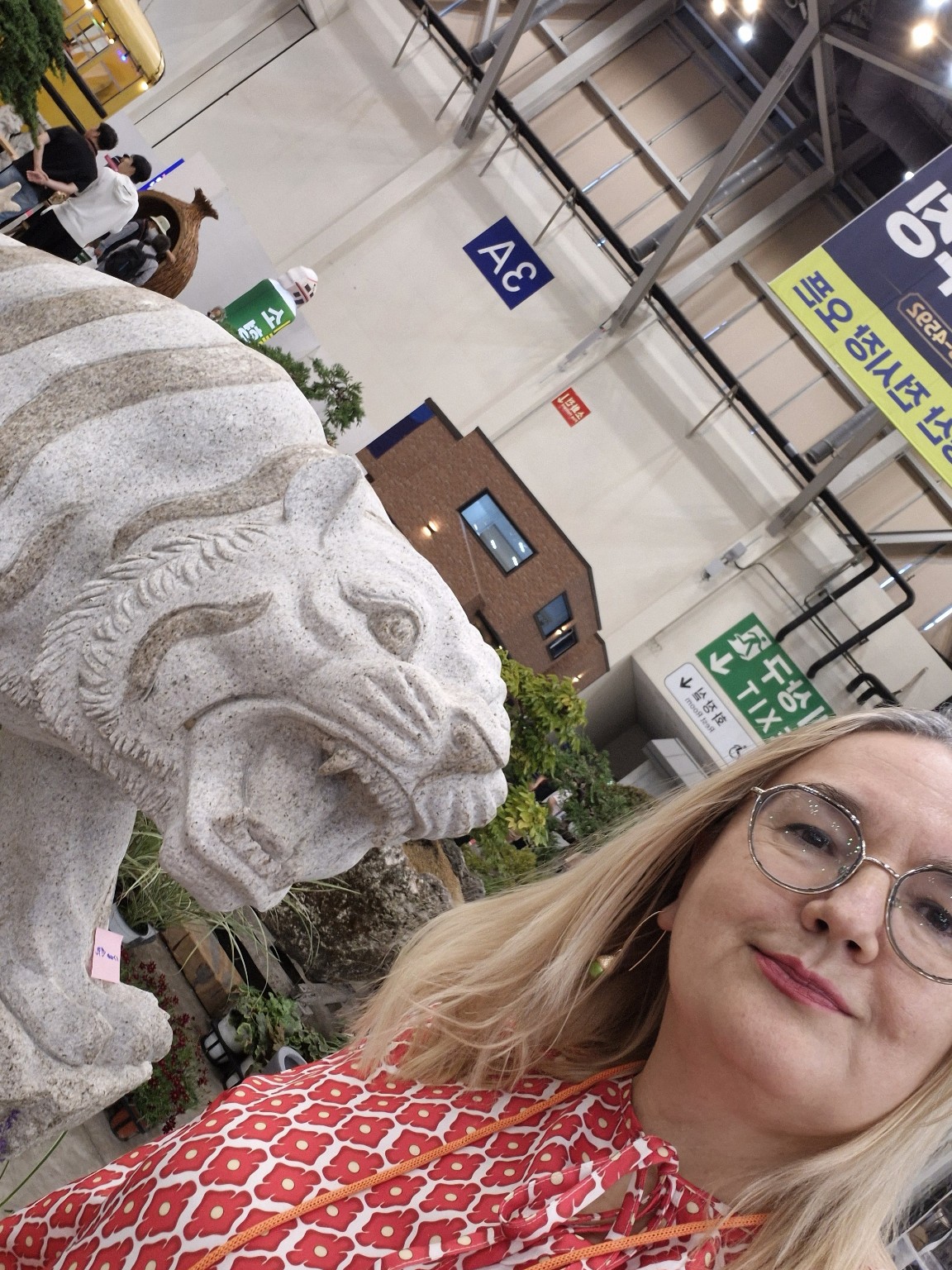
Stone sculpture in the landscape display. Photo: Tanya Moroz.
6. Korean lifestyle retail looked more internationally styled than I expected
Before visiting, I expected traditional Korean visual culture to be more visible in home decoration.
I expected to encounter more calligraphy, ink painting or contemporary reinterpretations of Korean graphic traditions.
Instead, much of the decorative imagery I saw leaned toward Western or internationally familiar aesthetics, including reproductions and decorative art that could have been displayed in European interiors.
Again, this is not evidence about the entire Korean home-decoration market.
But it creates an interesting question:
How much of mainstream Korean interior decoration is globally convergent, and where does specifically Korean visual identity enter the home?
For a European furniture or décor company, the answer matters because it determines whether Korea should be treated primarily as a culturally distant design market or as a sophisticated global consumer market with specific local layers.
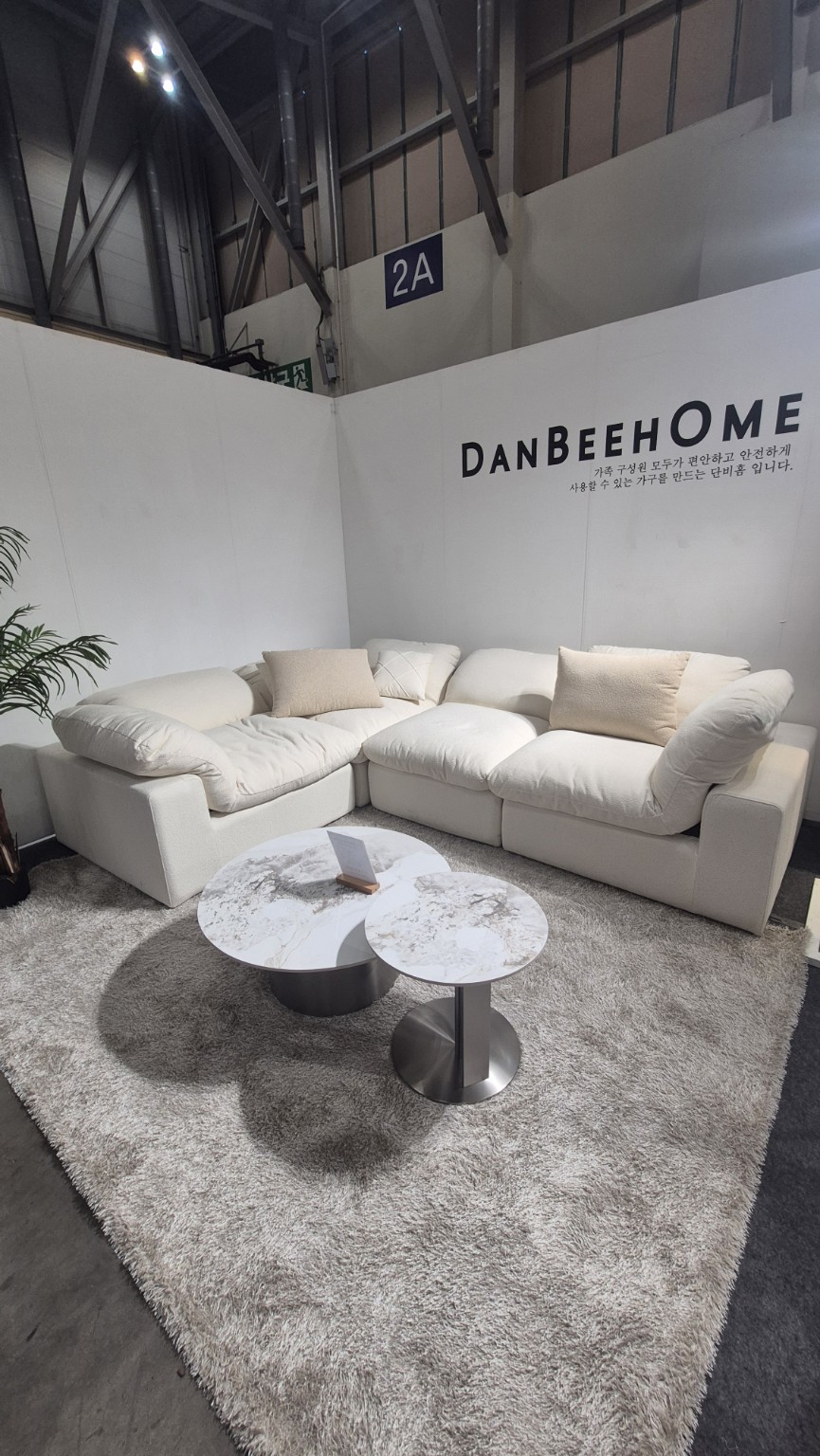
Danbeehome furniture display at Living & Lifestyle. Photo: Tanya Moroz.
7. “Home” in Korea extends naturally into wellness
Another striking feature was the way home-living products blended into personal wellbeing.
I encountered:
- vibration exercise equipment;
- home wellness devices;
- heat- and comfort-oriented products;
- relaxation products;
- and even a barrel-style sauna.
The official Living & Lifestyle programme itself explicitly included healthcare equipment among its categories, alongside furniture, appliances and interior accessories. 리빙앤라이프스타일
This makes the Korean concept of “living” interesting from a European commercial perspective.
The home is not marketed only as a designed space.
It is also marketed as a place for:
recovery, exercise, relaxation and personal care.
That creates potential crossover opportunities for companies working in:
home wellness, compact saunas, recovery equipment, ageing-related home products, relaxation technology and health-adjacent consumer devices.
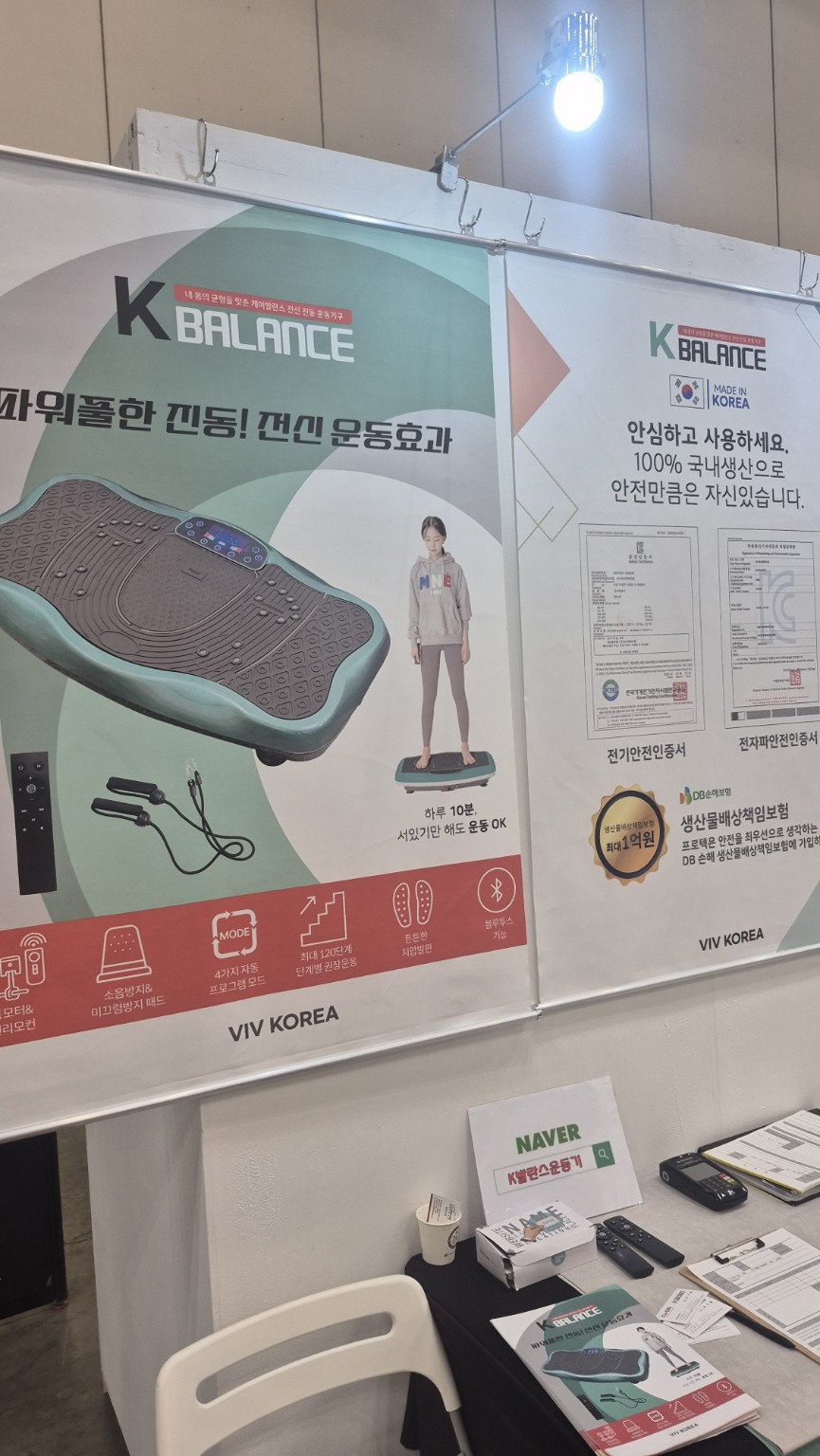
K-Balance home wellness equipment display. Photo: Tanya Moroz.
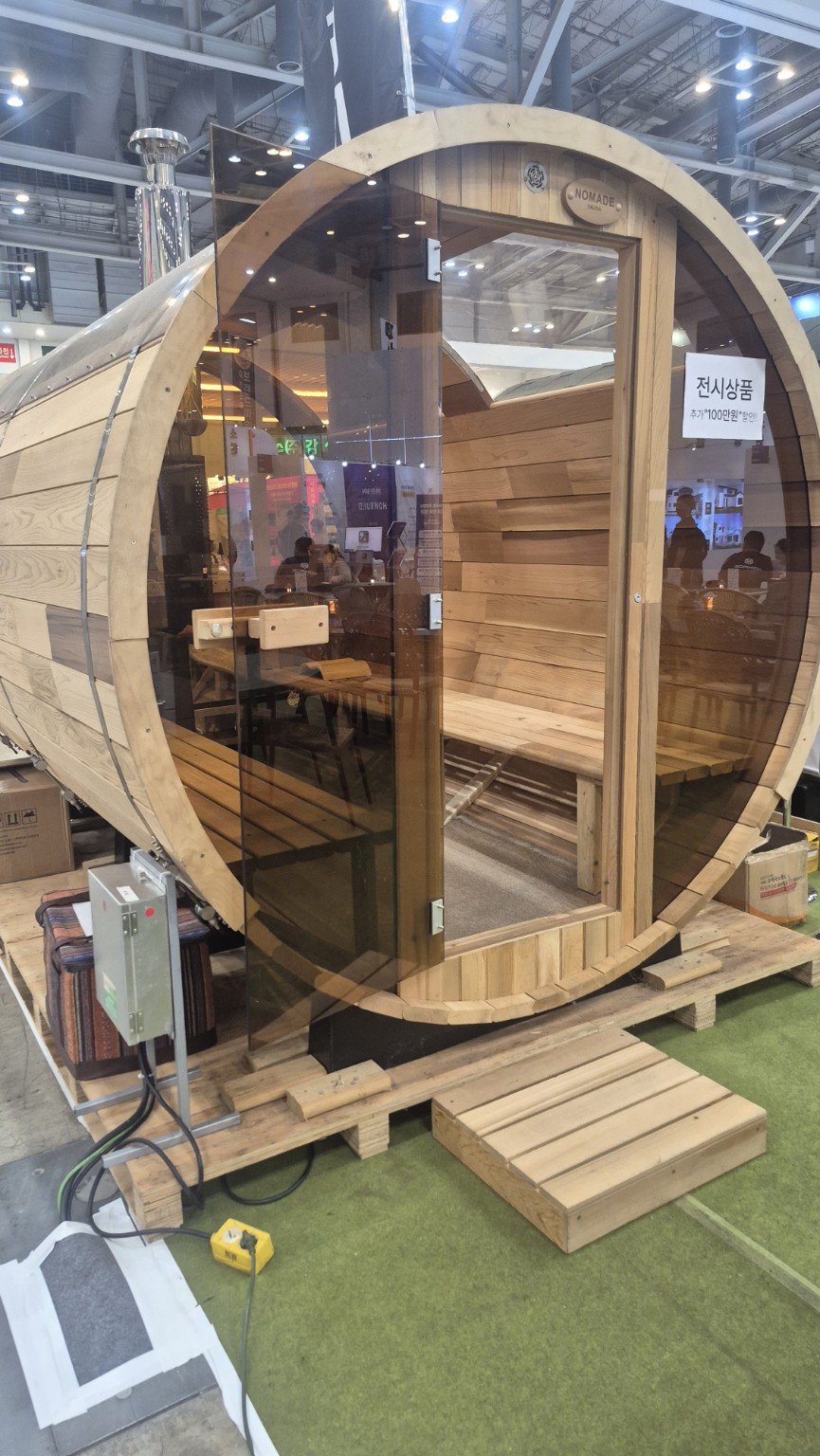
Barrel-style sauna on display. Photo: Tanya Moroz.
This was not only a trade fair. It was a marketplace.
One of the clearest observations from the floor was how commercially active the exhibition was.
Products were being offered with visible exhibition discounts. Ceramics were sold directly. Modular houses displayed promotional pricing. Wellness products were demonstrated to visitors. Exhibition samples were offered for sale.
This was not accidental.
The organiser explicitly ran a purchase promotion in which visitors spending KRW 200,000 or more at the exhibition could submit receipts for prizes, with higher prize tiers for purchases of KRW 500,000 and KRW 1 million. 코리아빌드 : 대한민국 대표 글로벌 건축박람회, 인테리어 박람회
That is useful intelligence for foreign exhibitors.
Korea Build / Living & Lifestyle is not merely a place to meet distributors or collect business cards.
It can also function as a live consumer-testing environment.
A company can observe:
- who stops;
- what questions visitors ask;
- what features attract attention;
- whether people understand the product;
- how price-sensitive they are;
- and whether interest converts into purchases.
For a new entrant, this may be almost as valuable as a formal market survey.
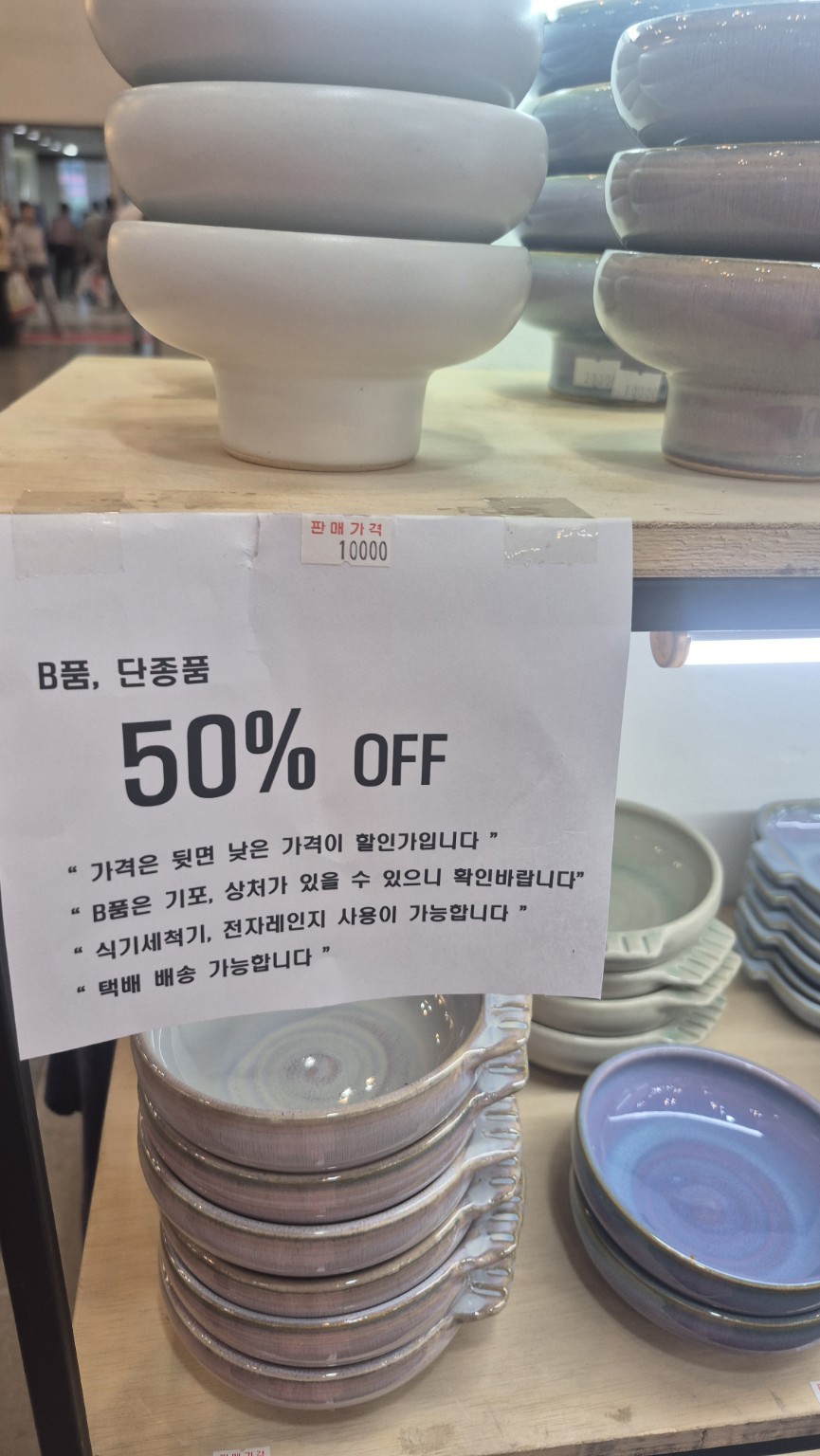
Ceramics marked 50% off at the exhibition. Photo: Tanya Moroz.
A hybrid audience: professionals and consumers in one place
The visitor mix also explains why the exhibition felt unusually broad.
According to the organiser’s 2025 analytics for Living & Lifestyle, the largest visitor group was people actively seeking interior solutions, but the audience also included building owners, designers, contractors, architects, engineers, construction companies, public-sector bodies and building-material manufacturers.
The reported reasons for visiting included interior/remodelling research, tracking new technologies, construction and design projects, purchases and contracts, and finding new business contacts. 리빙앤라이프스타일
Professional programming was running alongside consumer-facing sales. Korea Build included architectural seminars and one-to-one sessions for architects, designers, engineers and construction-management professionals. Южный университет
That combination is commercially important.
A single exhibition visit can provide information about both:
industry structure and consumer response.
What I would investigate next for a European client
My visit did not produce a list of final market conclusions. It produced something more useful: a set of hypotheses worth testing.
For a European company considering South Korea, I would investigate six areas next:
- Exterior siding and façade systems
Is the apparent mismatch between limited exhibition supply and visitor interest reflected in the wider market? - Flooring distribution
Why was flooring less prominent than expected, despite being an official exhibition category? - Korean kitchen functionality
Could Korean sink and food-waste handling solutions represent an export opportunity or product-development idea for Europe? - Home wellness
How large is the Korean market for home-based relaxation, recovery and health-adjacent devices, and which products are exportable? - Landscape localisation
Which European outdoor and garden products can transfer directly, and which need Korean aesthetic adaptation? - Exhibitions as market-testing platforms
Can an overseas manufacturer use Korean consumer exhibitions to test product appeal before appointing a distributor or making a larger investment?
Those are all questions that require more than Google.
They require somebody to look, compare, ask and verify on the ground.
Field note: why local observation matters
This exhibition gave me a useful illustration of the role I want Korea Market Scout to play.
Some things were easy to learn online: dates, exhibitors, product categories and seminar programmes.
Other things were not.
A website could tell me that kitchen sinks were exhibited.
It could not automatically tell a European client why their design felt different to me after living in Korea.
The organiser could list flooring as an official product category.
Only walking through the halls allowed me to notice how little visual presence it appeared to have compared with what I would expect in Europe.
A catalogue could show siding.
It could not tell me that a relatively limited display had attracted a cluster of interested visitors at the moment I passed it.
Those observations are not substitutes for quantitative market research.
They are signals.
And good market intelligence often begins with noticing the right signal.
About this field report
I visited Korea Build / Living & Lifestyle Busan 2026 in person at BEXCO in Busan, South Korea.
This report combines:
- direct exhibition-floor observation;
- photographs and video recorded during my visit;
- product and pricing information visible at the exhibition;
- and publicly available information from the organiser and Korean public sources.
It is an independent field report, not a commissioned report from the exhibition organiser or any exhibitor.
Field research and photographs: Tanya Moroz, Busan, South Korea.
← Back to Korea Market Scout / Field Reports | Capacity Home
CAPACITY / KOREA MARKET SCOUT
Need someone on the ground in South Korea?
Tell us what you need. Let’s discuss how we can help.
Based in Busan, South Korea
Connect on LinkedIn
© 2026 CAPACITY | South Korea · Europe
We use the information you provide to respond to your inquiry.
You can also email us at info@capacity.ee.